
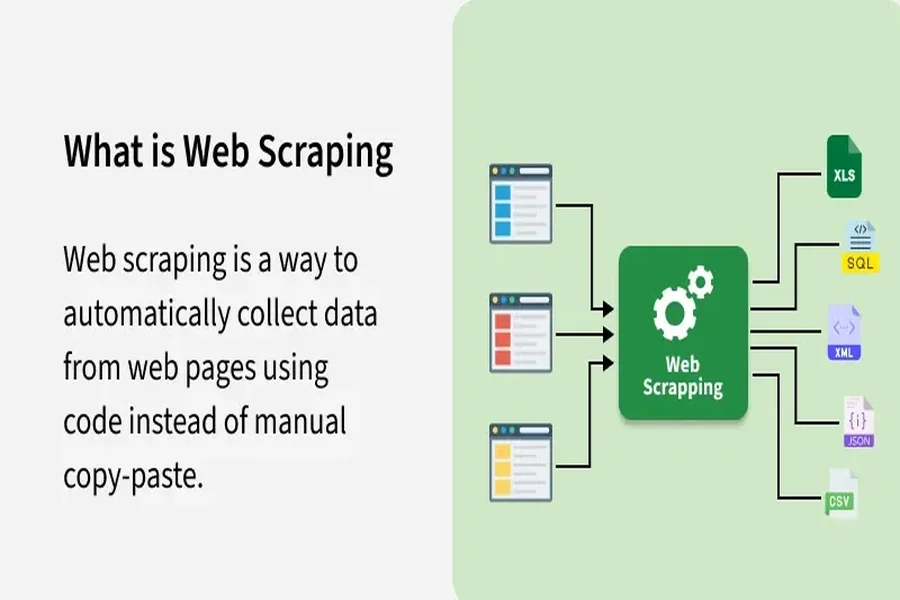
The web is full of data and web scraping is the automatic extraction of this data, as opposed to its manual extraction. This work has been dominated by Python due to its syntax that is readable and the amazing array of libraries developed in the field of data collection and processing. The knowledge of automated web scraping Python software tools opens a variety of practical applications such as price monitoring, research data collection and more.
In reality, what Web Scraping is.
Web scraping is the automatic procedure of making Web page requests that process the web page content to get out the particular information. A scraper accessing a URL retrieves the HTML of the page discovers the information it wants – a price of a product a news article a contact name – and stores that information in a useful format.
Well done is an effective data journalism instrument that data journalists researchers marketing professionals and developers. Poorly or otherwise against the terms of service of a web site it may lead to legal and ethical issues. It is always important to look into the robots.txt file and terms of service of a site before scraping.
The most popular Web scraping language is Python.
Web scraping could be done with any language, but the Python language has become the default option. The reasons are practical.
Libraries are very good. The Python ecosystem has a tool to handle all aspects of the scraping task such as sending HTTP requests to HTML to process JavaScript-rendered web pages to handle delays and rotating proxies and storing the data collected.
The syntax is readable. Even by individuals who have not written it a Python web scraper can sometimes be perceived at a glance. This is significant to upkeep and teamwork.
There is much community support. Any issue that you face during web scraping using Python has most likely been addressed and written somewhere. Getting solutions is quick.
BeautifulSoup and Requests The Time-honoured Duo.
Simple scrapers using Python start with the Requests library and BeautifulSoup to form the foundation of their scrapers.
Request is the HTTP side – the transmissions of GET or POST request to URLs and the response. BeautifulSoup processes the HTML returned and offers methods of navigation and search of the document tree. You may find elements using either the class attribute or CSS selector.
This mixture is good in simple scraping processes in which the information is being served directly in HTML. All good candidates include product listing blog posts and contact directories on basic sites.
It has the limitation of not being able to process JavaScript-rendered content with Requests and BeautifulSoup. Numerous contemporary Web sites are loaded dynamically through JavaScript and thus the HTML sent back by a simple HTTP request is an empty shell.
Selenium Selenium is a web testing tool that can scrape web pages that are heavy with JavaScript code.
Selenium is designed to test browser automation, but has become popular as a tool to scrap the web. It manages a real browser (Chrome or Firefox) that is, it fully supports JavaScript, and can interact with the objects as a typical user would.
Selenium is the tool that allows clicking buttons fill in forms scrolling to load lazily and wait until a particular element has been loaded before selenium extracts it. This can enable it to scrape practically any webpage no matter how intricate the JavaScript may be.
Speed and resource use is the trade-off. Selenium is much slower than Requests-based scraping as it uses a complete browser to execute an operation. This overhead can accumulate quite a lot in scraping thousands of pages.
Playwright – Modern Selenium Alternative.
Playwright is a more recent browser automation library, which has quickly become popular. It is quicker than Selenium supports various browser engines and its API is more modern, which enables asynchronous scraping to be written simpler.
The support of asynchronous is especially useful when scraping large scale in which having several requests running at a time is much better than having one. In certain situations, playwright is more supportive of intercepting network requests, enabling more elegant data extraction.
New projects with the need to render with JavaScript are increasingly likely to use Playwright over Selenium.
Scrapy — Industrial-Scale Scraping
Scrapy is not only a library but is a complete web crawling and scraping framework. Large-scale scraping projects are designed to be scaled to many pages, where you require to crawl numerous pages, and efficiently use requests and save data in various formats.
Scrapy has a structured architecture that supports middleware pipelines of concurrency and throttling of requests. It has in-built features of tracing links throughout a site that exports data to CSV JSON or databases and connects with proxies.
In a single scraping Scrapy can be thought of as excessive. It is the right tool to the pipelines that require continuous data collection and need to scrape hundreds of thousands of pages on a regular basis.
Handling Anti-Scraping Measures
There are numerous sites that have procedures that identify and prevent scrapers. Knowing these will enable you to create more powerful tools.
The most popular measure is rate limiting. Too rapid scraping results in detection. Introduction of delays between requests – random delay that simulates human behaviour – has a much greater chance of preventing being blocked.
User agent rotation is a technique that can be used to prevent the same automated client being identified on subsequent requests by rotating the browser identifier sent with each request.
The proxy rotation will ensure that it uses various IP addresses to make the requests to ensure that a certain IP does not make an abnormal request. Paid proxy services provide set of rotating residential IP, which is more difficult to detect and block than datacenter IPs.
The most challenging obstacle is CAPTCHA challenges. There are some services that can be used to solve CAPTCHAs programmatically but they are more expensive and complex. The more holistic long-term solution to noteworthy sources of data has been to look at the existence of an official API.
Saving and processing Scraped Data.
Scraping will not be of any benefit unless you use the data. Storage methods common to common storage approaches are CSV files to store simple flat data, SQLite or PostgreSQL databases to store structured queryable data and JSON files to store hierarchical data which naturally maps to the structure of the web.
Python Pandas library is typical following a scrape to cleanup deduplicate and analyse data that has been collected before storing or utilising it.
Final Thought
Python web scraping software allows you to gather data in large quantities in a scalable manner, across the web. Begin with BeautifulSoup and Requests with basic static websites. Require JavaScript rendering: add Selenium or Playwright. When scale and reliability are the factors of interest move to Scrapy. Always scrub with respect to ethics of robots.txt verifying terms of service and delays so as to not to overload the server. The skills you build here transfer directly into data engineering machine learning pipelines and research workflows.
FAQs
Q: Is web scraping legal? It depends on what you scrape and how you use the data. Scraping publicly available information for personal or research use is generally acceptable. Violating a site’s terms of service scraping copyrighted content or using scraped data commercially can create legal issues. Always check before scraping.
Q: What is the difference between web scraping and web crawling? Web scraping extracts specific data from pages. Web crawling systematically browses many pages following links to discover content. Scrapy for example is both a crawler and a scraper.
Q: Can Python scrapers handle websites that require login? Yes. Using Requests sessions or Selenium you can automate the login process and then scrape content that requires authentication. Be cautious about terms of service which often restrict automated access to authenticated areas.
Q: How do I avoid getting blocked while scraping? Add random delays between requests rotate user agents use proxies for high-volume scraping and respect robots.txt. Scraping during off-peak hours also reduces the risk of triggering rate limiting.
Q: Are there alternatives to scraping if I need data from a website? Yes. Many websites offer APIs that provide structured data access. This is always preferable to scraping when available — it is faster more reliable and less likely to violate terms of service.
